


Quemerford Rule The Gasworks as Relay Record Caps 21-Gold Haul
GB Individual National Championships (19th August 2026)
Quemerford Harriers dominate the medal table with 36 medals, Iron Road Runners take second and a national record falls in the men’s 4×100m as Britain’s leading athletes battle for individual honours.
By Justin Lane, Chief Correspondent
Quemerford Harriers turned the GB Individual National Championships into a demonstration of extraordinary strength in depth at The Gasworks, collecting 21 gold medals — 15 more than second-placed Iron Road Runners.
A crowd of 22,803 watched under cloudy skies as Quemerford accumulated 36 medals — 21 gold, ten silver and five bronze — to finish emphatically at the top of the medal table.
Iron Road Runners took second with six golds, seven silvers and five bronzes, while Bumble Bees AC finished third with five victories despite collecting 21 medals, three more than Iron Road.
Weymouth Bay Sharks followed with four golds and 17 medals, ahead of Hacksaws, whose three victories were accompanied by eight silvers and nine bronzes.
For all Quemerford’s individual success, the defining moment came when four athletes shared the track.
Their men’s 4×100m team set a national record of 44.99, adding the most important mark of the championships to an already overwhelming medal haul.
It was that kind of day for Quemerford.
| Club | Gold | Silver | Bronze |
|---|---|---|---|
| Quemerford Harriers | 21 | 10 | 5 |
| Iron Road Runners | 6 | 7 | 5 |
| Bumble Bees AC | 5 | 6 | 10 |
| Weymouth Bay Sharks | 4 | 6 | 7 |
| Hacksaws | 3 | 8 | 9 |
Leading 5 clubs from season 107 GB INCs
Quemerford Win Everywhere
Thirteen of Quemerford’s titles came from the men’s programme and another eight from the women’s, with victories stretching from the sprints to the walks, field events, combined events and relays.
William Ellis produced a personal-best 22.11 to win the men’s 200 metres, while Sean Grieveson took the 400 metres in 50.24.
Amy Herriot delivered another personal best in the women’s 400 metres, winning in 53.92, before Quemerford completed a hurdles double through Darren Wooderson and Sarah Brennan. Brennan’s 17.25 in the women’s sprint hurdles was also a personal best.
The success continued when the distances lengthened.
Amy Bradshaw won the women’s 800 metres in 2:09.94 and Sarah Roxburgh took the 1500 metres in 4:16.07. Jason Flavell won the men’s 3000 metres steeplechase, while Adam Innes and Mia McLeish claimed the men’s and women’s 5000 metres.
McLeish’s 16:04.00 was one of Quemerford’s strongest endurance performances of the championships.
The walks brought further gold through Logan McPherson, who won the men’s 10 kilometres in 48:28.74, and Zachary Shrubb, winner of the 20 kilometres in 1:36:27.83.
If Quemerford’s track programme was formidable, their field athletes refused to be overshadowed.
Ashley Ross completed a rare double by winning the pole vault at 5.59 metres and the triple jump with a personal-best 14.46 metres.
Daniel Gilbride matched him with two titles of his own, winning the shot with 21.76 metres before taking the hammer at 65.55 metres.
Abigail Darling completed another Quemerford victory in the women’s discus with 67.86 metres.
The combined events added gold through Ryan Redmond, who won the male pentathlon with 4,555 points.
That title contained one of the more unusual results of the day. Iron Road’s Kai McAuliffe also finished on 4,555 points but was placed second.
Then came the relays.
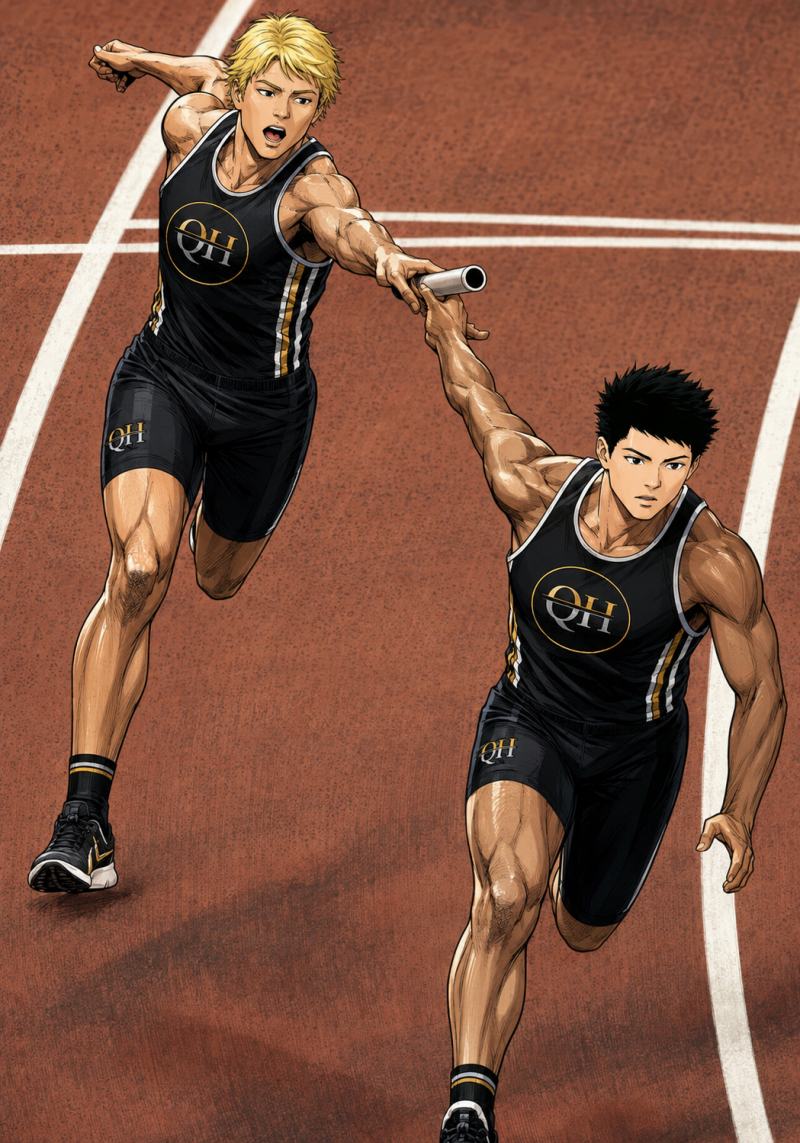
Quemerford Harriers men's 4x100m Relay team set a new GB National Record in 44.99 seconds
Quemerford’s national-record 44.99 won the men’s 4×100m, the women took their 4×100m title in 49.85, and the women’s 4×400m team added another gold in 3:46.38.
Only the men’s 4×400m escaped them, and even there Quemerford finished second behind Weymouth Bay Sharks.
By then the medal table had long since acquired a familiar leader.
Iron Road Take Second With Six Men’s Titles
Iron Road Runners finished second despite all six of their gold medals coming from the men’s programme.
Joe Canning opened their title account with victory in the men’s 100 metres in 11.21, while Craig East won the 800 metres in 1:58.96.
Their endurance strength surfaced again in the longest walk, where Jamie McGeechan won the men’s 50 kilometres in 4:00:23.85.
Two throwing titles strengthened the challenge further. Aiden Hillcoat won the discus with 67.41 metres, while Murray Tierney took the javelin at 70.67 metres.
The sixth gold came from one of the championship’s standout combined-event performances.
Kai McAuliffe won the decathlon with 9,233 points, having already collected silver in the male pentathlon.
Iron Road finished with 18 medals, fewer than both Bumble Bees and Hacksaws, but their six victories were enough to secure second place on the medal table.
Bumble Bees Turn Podiums Into Third Place
Bumble Bees AC actually collected more medals than Iron Road, finishing with 21, but five golds left them third.
Their champions came from very different parts of the programme.
Evie Gardiner produced a personal-best 1:04.37 to win the women’s 400 metres hurdles, while Spencer Easton took the men’s 1500 metres in 3:49.01.
Demi Boyle won the women’s 3000 metres steeplechase in 14:01.56 before Tilly McWilliam delivered one of the strongest walking performances of the championships with 1:45:34.76 to win the women’s 20 kilometres.
The field supplied their fifth title through Megan Sweeney, who won the women’s hammer with 59.28 metres.
Bumble Bees were regular visitors to the podium even when gold escaped them. Six silvers and ten bronzes gave them the second-highest overall medal total behind Quemerford.
The combined events contributed to that depth, with Craig Rougvie taking decathlon bronze on 8,621 points and Ellie Menzies finishing third in the female pentathlon with 4,353.
Weymouth Strike Through Sprints, Distance and Relays
Weymouth Bay Sharks finished fourth with four golds, six silvers and seven bronzes.
Their first major success came from Kara Sanderson, whose personal-best 11.86 won the women’s 100 metres.
Kate Severin added the women’s 10,000 metres title in 35:36.63, and Zara Wayman cleared 4.08 metres to win the women’s pole vault.
Weymouth’s fourth title came in the men’s 4×400m, where they won in 3:34.26 ahead of Quemerford.
There was further sprint quality from Eloise Cooke, who collected two silver medals. She finished second in the women’s 200 metres before running a personal-best 54.58 for silver over 400 metres.
Severin returned to take bronze in the women’s 5000 metres with a personal-best 16:50.67, while Erin Moscardini collected heptathlon bronze with 5,760 points.
It left the Sharks with 17 medals and fourth place in a championship where victories, rather than total podium appearances, determined the order.
Hacksaws Collect 20 Medals But Only Three Golds
Few clubs demonstrated that point more clearly than Hacksaws.
Their 20 medals were bettered only by Quemerford and Bumble Bees, yet just three were gold, leaving them fifth.
Those three titles all came in the endurance events.
Kyle McDougall won the men’s 10,000 metres in 31:26.93, before Henry McMahon produced a personal-best 2:13:59.42 to take the men’s marathon.
Mia Duke completed a marathon double for Hacksaws by winning the women’s race in 2:33:07.77.
Around those victories came a stream of near misses.
Joseph Cunningham took silver in both the men’s 10- and 20-kilometre walks. Anthony McLaughlin ran a personal-best 3:53.60 for silver in the 1500 metres and later added bronze in the 3000 metres steeplechase.
Hacksaws also took medals in every relay — silver in the men’s 4×100m and bronze in the women’s 4×100m and both 4×400m races.
Eight silver medals and nine bronzes told the story of a club consistently near the front without converting enough of those opportunities into victories.
McColl Leads Caledonian and Sets Combined-Event Best
Caledonian finished sixth with two golds and 12 medals, and their biggest moment came in the heptathlon.
Ellie McColl won the title with 6,693 points.
During the competition she also ran 2:12.00 in the heptathlon 800 metres, recorded as a national best for that discipline within the combined event.
Caledonian’s other champion was Carla Regis, who produced a personal-best 4:26:40.11 to win the women’s 50-kilometre walk.
Michael Goldie twice reached the podium in the throws, producing personal bests of 21.75 metres for silver in the shot and 67.29 metres for bronze in the javelin.
Reading Palm Faces did not win a title, but they produced another important combined-event story.
Sebastian Dickson scored 9,083 points to take decathlon silver behind McAuliffe. Within those ten events, Dickson recorded national combined-event bests of 7.00 metres in the long jump and 4.22 metres in the pole vault.
Reading also took heptathlon silver through Hollie Ancell, who finished with 6,097 points.
Champions Spread Beyond the Leading Five
Pineapple AC finished seventh with two gold medals.
Samuel Boyle won the men’s 400 metres hurdles in 59.10, while Melissa Wood cleared 1.77 metres to take the women’s high jump.
E-LDN Surge had a national champion in Fiona Maguire, winner of the women’s triple jump with 10.98 metres.
Natasha Niven ensured Grimsby Harriers also left The Gasworks with gold after winning the women’s 200 metres in 24.43.
Chios Track Club’s Alexandra Lineen produced a personal-best 57.02 metres to win the women’s javelin.
There were also championship victories for athletes attached to clubs outside the main British league contingent.
Sophia Shepherd of TuS Erbse won the women’s 10-kilometre walk, Peter McNeill of Astrapi took the men’s high jump and Peter McConnell of Marsa Sports Club won the men’s long jump.
Rebecca Lewis of Txuario produced a personal-best 6.03 metres to win the women’s long jump, while Angers club’s Isla Haddock took the women’s shot at 20.27 metres.
In the combined events, Zadar United’s Sarah Joyce won the female pentathlon with 4,460 points.
Record-Breaking Finish to a Dominant Day
The championships ultimately belonged to Quemerford.
Iron Road had the decathlon champion. Bumble Bees collected 21 medals. Weymouth won the men’s 4×400m and Hacksaws kept appearing on podiums throughout the programme.
None could match Quemerford’s ability to turn opportunities into gold.
Twenty-one victories from 52 championship events was an extraordinary return, backed by another 15 silver and bronze medals.
And among all those medals came the performance that gave the championships their record-breaking moment.
Quemerford’s men stopped the clock at 44.99 in the 4×100m.
A national record, another gold medal and the perfect final statement from the club that ruled The Gasworks.