


GB Individual Regional Championships – Season 107
Sherwood Sets the Standard as 1,162 Entries Qualify
Wednesday 29th July 2026
Caledonian’s Beth Sherwood produces the outstanding performance, the South West stages Britain’s deepest regional contest and Iron Road Runners lead the qualifiers
By Justin Lane, Chief Correspondent
Beth Sherwood provided the headline performance as Britain’s Individual Regional Championships sent 1,162 entries through qualification after a day of contrasting battles across 14 active regions.
The Caledonian runner completed the East Scotland women’s 10,000 metres in 37:03.12, the fastest time recorded in the event anywhere in the regional programme. It earned Sherwood The Daily Pole Vault’s Athlete of the Tournament award and crowned an outstanding East Scotland championship in which Caledonian and Iron Road Runners repeatedly set the national standard.
Elsewhere, the nature of the competition varied dramatically.
The South West of England brought five clubs and 320 entries into the busiest and most difficult regional meeting. Quemerford Harriers and Weymouth Bay Sharks fought for victories at the front, while Filham Excelsior demonstrated the importance of the national rankings by progressing 57 entries despite winning only four events.
South London produced the closest contest for regional supremacy, with Hacksaws and Kingstonians dividing the programme almost equally. Yorkshire and the Humber displayed remarkable depth behind its winners, while Bumble Bees AC and Pineapple AC established clear advantages in North and South Wales respectively.
Other regions offered no direct club rivalry at all. Draco Velox, E-LDN Surge, Kings Park Harriers and Newcastle Athletic Club competed without regional opposition, leaving the clock, tape measure and national top-20 rankings as their more meaningful tests.
Across the championships, 1,396 entries were recorded. The regional automatic places accounted for 786 qualifiers, while another 376 progressed by ranking among the leading 20 performances nationally.
Conditions ranged from sunshine to cloud and overcast skies. Wendy Gust reported sunshine in 11 of the 19 listed regions, cloud in three and overcast conditions in five. Central London, North London, Northern Ireland, West London and West Scotland had no listed entries, leaving 14 regions with active competition.
East Scotland Produces the Championship Standard
By Phil McCracken
East Scotland’s championship became a contest between Iron Road Runners’ considerable depth and a Caledonian team capable of producing several of the day’s finest individual performances.
Sherwood delivered the principal result, but her 10,000 metres victory was far from an isolated success for Caledonian.
Joel Quigley cleared 4.78 metres in the men’s pole vault, the best performance recorded across the regions, while Ellie McColl led the heptathlon with 6,073 points. Those results ensured that Caledonian remained prominent even as Iron Road assembled the largest qualifying group of the championships.
Abi Hynds provided one of the most impressive runs of the day for Iron Road. Her personal-best 4:21.76 placed her at the head of the women’s 1500 metres results and underlined the club’s strength beyond its large entry.
The walkers then gave Iron Road a sustained advantage.
Joe Severin completed the men’s 20 kilometres in 1:41:18.14, before Jamie McGeechan recorded 4:02:08.23 over 50 kilometres. Madeleine Davidson made it three nationwide-leading walking performances for the club with 4:38:57.78 in the women’s 50 kilometres.
Iron Road were just as influential in the throwing circle.
Aiden Hillcoat reached exactly 65.49 metres in both the men’s discus and hammer, finishing ahead of every other regional performance in the two events. Murray Tierney added another national leader with 18.06 metres in the shot.
Kai McAuliffe completed the club’s strongest sequence by winning the male pentathlon with 4,425 points, an average of 885 across the five disciplines.
Iron Road ultimately advanced 85 of their 95 entries, more than any other club in Britain. Caledonian qualified 39 from 41, giving East Scotland a combined return of 124 qualifiers from 136 starts.
Two automatic places were available in each event, but the region’s quality extended far beyond them. Twenty East Scotland entries still had to earn their positions through the national top-20 rankings.
Iron Road supplied the greater numbers; Caledonian supplied the outstanding athlete. Together, they gave East Scotland the strongest overall championship of the day.
South West Athletes Survive Britain’s Deepest Fields
By Paige Turner
No region placed more entries into competition than the South West of England, and nowhere was the route to qualification more demanding.
Filham Excelsior, Isca Harriers, Millbrook AC, Quemerford Harriers and Weymouth Bay Sharks combined for 320 starts beneath cloudy skies. With only two automatic places available in each event, hundreds of athletes knew that beating local rivals might not be enough—and that losing to them did not necessarily mean elimination.
Quemerford and Weymouth established themselves at the front of the regional contest.
Quemerford led 26 events and produced the best result in Britain in 12 of them, more nationwide leaders than any other club.
Mia McLeish completed the women’s 5000 metres in 17:02.40, while Abigail Darling reached 64.74 metres in the women’s discus. Ryan Redmond carried Quemerford’s strength into the combined events, leading the decathlon with 8,728 points.
The Harriers also produced national-leading performances across the women’s 400 metres, sprint hurdles, 800 metres, shot and javelin, and the men’s 200 metres, 400 metres and javelin. Their championship was not built around one athlete or one discipline, but around quality throughout the programme.
Weymouth Bay Sharks answered with 22 regional victories and seven performances that led the nationwide results.
Max Shewan recorded 14:41.19 in the men’s 5000 metres, while Jason Dixon headed the sprint hurdles in 18.02. Zara Wayman cleared 3.69 metres in the women’s pole vault and Leah McIntyre led the female pentathlon with 4,099 points.
The Sharks’ men’s 4×100m relay also produced a personal-best 48.78, the performance selected for the tournament’s relay honour.
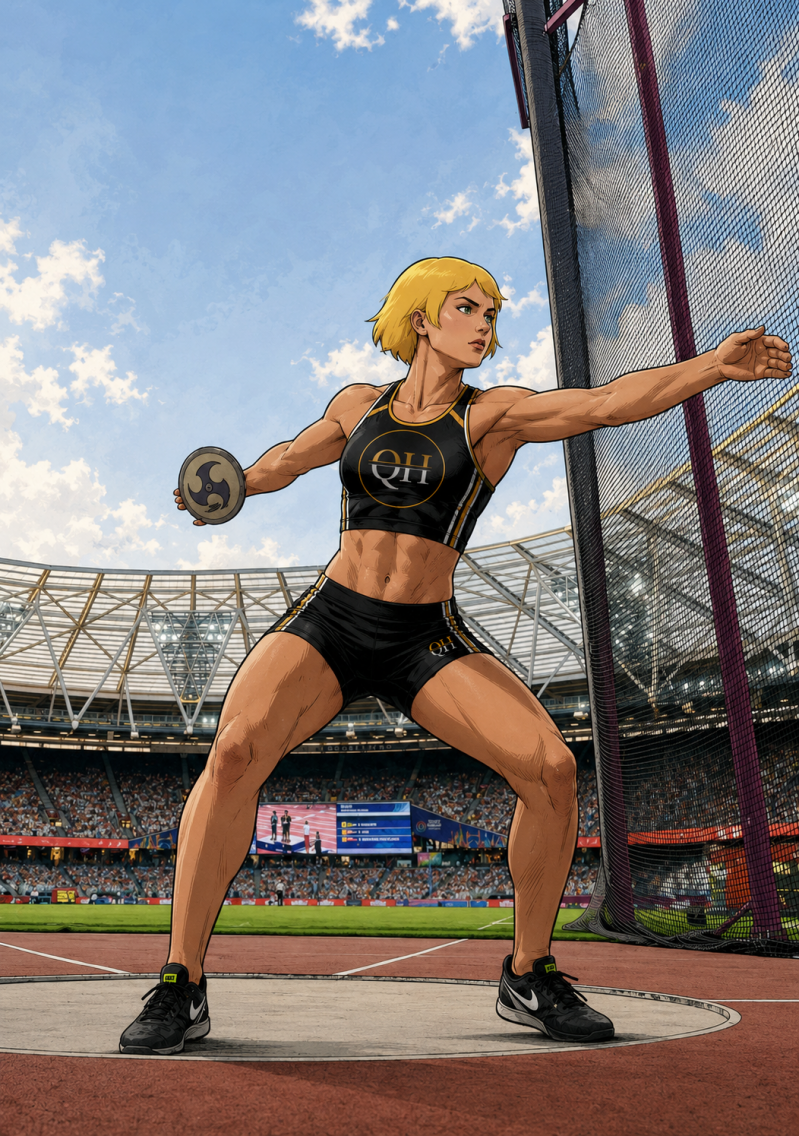
Abigail Darling of Quemerford Harriers launches the discus 64.74m
The regional victory count favoured Quemerford, but the qualifying totals could scarcely have been closer. Weymouth advanced 59 entries and Quemerford 58.
Filham Excelsior provided an equally important story from behind the two leaders.
The club won only four events but progressed 57 of its 64 entries. Time after time, Filham athletes who had been beaten within the region performed well enough to earn a place through the national top 20.
That was less forgiving for Isca Harriers and Millbrook AC, who finished with 19 and 18 qualifiers respectively despite recording 66 and 65 entries. Neither club produced a regional winner in fields dominated by Quemerford and Weymouth.
By the end of the championship, 211 South West entries had qualified. Only 104 progressed automatically; another 107 had to earn their places through the national rankings.
The South West did not simply stage the largest regional meeting. It provided the clearest demonstration that qualification depended on far more than finishing position alone.
Bumble Bees Turn North Wales Advantage into National Results
By Bill Board
Bumble Bees AC held an overwhelming advantage in the North Wales championship, leading 48 of the 52 events contested against Rhyl Runners.
That margin reflected the current difference between the two clubs, but the most significant Bumble Bees performances were those that remained impressive when compared beyond the region.
Kimberley Combe supplied the finest example.
Her 5.58 metres in the women’s long jump led every regional result in Britain. Harley Hendry added a second North Wales long-jump success at 6.61 metres in the men’s competition.
The Bees also produced nationwide leaders on the track and in the endurance programme.
Evie Gardiner completed the women’s 400 metres hurdles in 1:08.00, while Demi
Boyle recorded 14:45.17 in the women’s 3000 metres steeplechase.
Duncan Ibbotson led the men’s marathon results with 2:25:25.20, and Tilly McWilliam completed the women’s 20-kilometre walk in 1:52:14.23.
Those performances gave the Bumble Bees championship substance beyond the predictable regional victory count.
The club advanced 64 of its 68 entries, with only four failing to qualify. Rhyl Runners secured 24 places from 75 starts, including 20 earned through the national top 20.
Rhyl’s four victories prevented a complete Bumble Bees sweep, and the size of their entry ensured that all 52 events contained a genuine two-club contest. Nevertheless, the difference in qualification was considerable.
North Wales sent 88 entries forward from 143, with the overwhelming majority of its leading performers wearing Bumble Bees colours.
Pineapple Establish Clear South Wales Supremacy
Pineapple AC produced a similarly commanding result in South Wales, although Risca Harriers AAC offered considerably stronger resistance behind the winners.
Pineapple led 43 of the 52 events in overcast conditions, with Risca taking the remaining nine.
Adam Mudge headed the men’s 1500 metres results in 4:08.06, while Dylan Whittaker produced the fastest regional 10,000 metres performance at 35:40.00.
Melissa Wood cleared 1.59 metres to lead the women’s high jump, and Pineapple’s men’s 4×400m relay recorded 3:44.42, the quickest time from any of the regional meetings.
The club’s advantage extended well beyond those nationwide leaders. Pineapple advanced 61 of its 62 entries, losing only one from its entire championship programme.
Risca also produced an excellent qualifying return. Forty-six of their 57 entries progressed, with 37 of those places coming through the national top 20 rather than automatic qualification.
Together, the two clubs sent 107 entries forward from 119 starts.
Pineapple supplied most of the champions, but Risca’s ability to remain competitive behind them ensured that South Wales emerged with one of the largest qualifying groups in Britain.
Draco Velox Race the National Rankings
Mid and West Wales presented an entirely different championship.
Draco Velox were the region’s only participating club, recording 64 entries in overcast conditions. With no local rival to defeat, their performances were judged primarily by whether they completed the event and how they compared with athletes elsewhere.
The club secured 51 automatic places and two additional top-20 qualifier, advancing 53 entries in total.
The only event that failed to produce a regional qualifier was the men’s discus, where Alan Montgomery retired from the competition.
Draco therefore left without the drama of a club battle, but with a substantial qualifying group and representation across almost the entire programme.
Hacksaws and Kingstonians Divide South London
By Penny Farthing
The closest contest for regional victories unfolded beneath overcast skies in South London.
Hacksaws led 27 events and Kingstonians 25, splitting the complete championship programme almost exactly in half.
The clearest Hacksaws advantage came in the relays.
Their women’s 4×100m team recorded 53.05 and the women’s 4×400m quartet completed their race in 4:03.98. Both were the quickest performances produced in their respective events across all regions.
Yet Kingstonians emerged with the larger qualifying group.
They advanced 57 entries, compared with 46 for Hacksaws, despite winning two fewer regional events. Kingstonians repeatedly placed additional athletes inside the national top 20, turning regional defeats into qualifying positions.
Only one automatic place was available from South London in each event, so every runner-up immediately entered a nationwide comparison.
That route supplied 51 of the region’s 103 qualifiers. Only nine of the 112 entries failed to progress.
Hacksaws left with marginally more regional champions. Kingstonians left with 11 more qualifiers. Neither club could claim complete control of a championship in which almost every advantage was answered elsewhere.
South East Qualification Becomes a Formality
The South East of England championship offered the most generous automatic allocation in Britain, with four places available from each contested event.
Reading Palm Faces and Budd Park Darts recorded 89 entries between them—and every one qualified automatically.
Reading led 31 of the 50 events in which the region was represented, while Budd Park headed the other 19.
Budd Park nevertheless supplied the region’s two nationwide-leading track performances.
Shaun Peters completed the men’s 400 metres hurdles in 1:01.82, while Victoria Greacen ran a personal-best 12.61 in the women’s 100 metres.
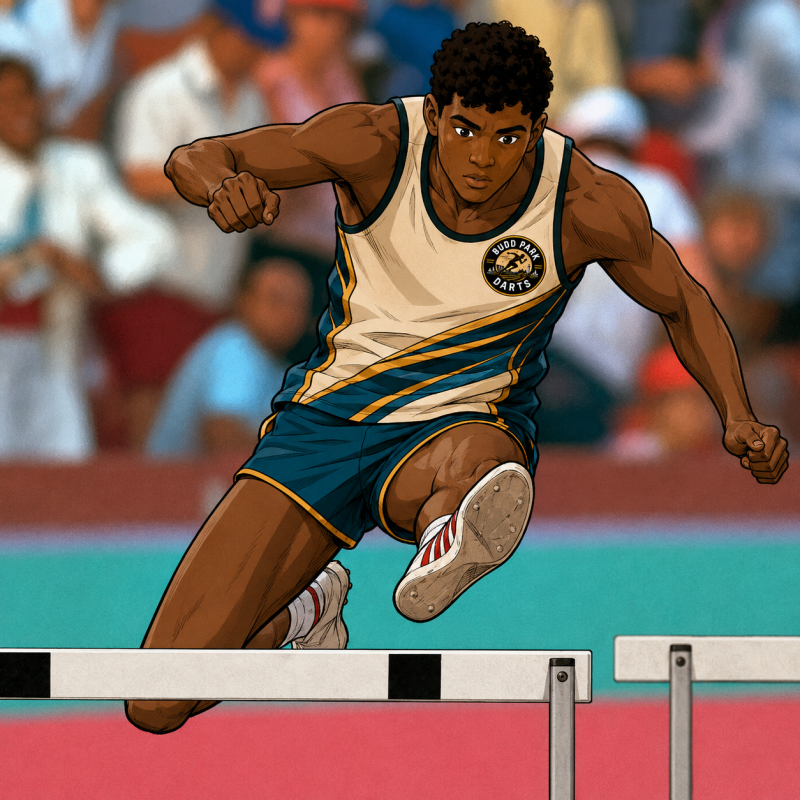
Shaun Peters powers home in the men’s 400 metres hurdles in 1:01.82
Reading progressed all 52 of their entries and Budd Park all 37. There was competition for regional victories, but none of the jeopardy faced in the South West, South London or Yorkshire.
For the South East clubs, the championship settled local positions without removing a single entry from the qualifying lists.
E-LDN Surge Make a Compact Programme Count
E-LDN Surge were the only active East London club and entered 31 times across a reduced programme.
Every one of those entries qualified automatically, but four Surge performances also led the nationwide results and required no protection from the region’s lack of opposition.
Luke McDaid completed the men’s 3000 metres steeplechase in 12:10.07.
Joshua Dobbie reached 12.38 metres in the men’s triple jump, while Fiona Maguire recorded 10.70 metres in the women’s competition. Georgia Jack added the leading women’s hammer mark at 47.51 metres.
East London did not possess the numbers to stage a full championship, but its strongest performances compared favourably with those produced in far larger regions.
Central London, North London and West London had no listed entries.
Leeds and Heworth Carry Yorkshire Strength Forward
By Terry Bull
Yorkshire and the Humber produced 128 entries and lost only seven of them from the qualifying lists.
Leeds United AC held the advantage in regional victories, leading 34 events to Heworth Harriers’ 18. The championship’s real strength, however, was found in the large number of athletes who progressed without winning.
Only one automatic place was available in each event. Yorkshire nevertheless advanced 121 entries, with 69 qualifying through the national top 20.
Leeds produced two nationwide leaders.
Leon Jeffrey headed the men’s 800 metres in 2:03.89, while Jenna Brady completed the women’s 10-kilometre walk in 57:27.33.
The club’s success extended well beyond those victories. Leeds advanced 65 of its 66 entries, the best qualifying return achieved by any large club apart from those competing under the South East’s four-place allocation.
Heworth progressed 56 of 62. Thirty-eight had to rely on a top-20 performance after finishing outside the single automatic position.
The result was one of the most impressive demonstrations of regional depth. Leeds supplied more winners, but both clubs repeatedly placed athletes among the best in Britain.
Yorkshire did not dominate the nationwide event leaders in the manner of East Scotland or the South West. Instead, it built one of the largest qualifying groups through remarkable consistency behind them.
DC AC Hold the Edge in the West Midlands
The West Midlands championship brought together DC AC and The Titans in sunny conditions.
DC AC led 30 events and The Titans 21, with the women’s 3000 metres steeplechase the only event receiving no regional entry.
The balance of victories gave DC AC the clearer claim to regional supremacy, but the qualifying totals remained close.
DC AC advanced 41 of their 47 entries. The Titans progressed with 36 from 39, losing only three competitors from their programme.
Twenty-six of the region’s 77 qualifiers earned their places through the national top 20.
The West Midlands did not produce a performance that led the nationwide results, but both clubs displayed enough consistency to ensure that the overwhelming majority of their entries survived.
Dunn Gives East Midlands Its Headline
The East Midlands championship was smaller and contained no relay entries, but BRC and Yellerbellies still produced an almost complete qualifying return.
BRC led 20 of the 32 contested events, while Yellerbellies took the other 12.
Robyn Dunn supplied the region’s outstanding performance by completing the women’s marathon in 2:45:34.38, the quickest time recorded across all the regional championships.
BRC advanced all 25 of their entries. Yellerbellies qualified 16 from 18, leaving only two East Midlands competitors outside the final lists.
The absence of relays and entries in 20 other events restricted the size of the championship, but the athletes who did compete were rarely eliminated.
Eastern Clubs Progress Without a Single Loss
Grimsby Harriers and Olympians recorded 53 individual-event entries in the East of England, and all 53 qualified automatically under the region’s two-place allocation.
Grimsby led 39 of the 41 contested events. Olympians, with a much smaller team, claimed the remaining two.
Neither club entered a relay team, and the region did not produce a nationwide event leader. Its achievement instead came through the complete qualifying return.
Grimsby advanced all 41 entries and Olympians all 12, ensuring that every East of England competitor who appeared on the result sheets progressed.
Kings Park Complete the North West Programme
Kings Park Harriers were the North West of England’s only active club but produced entries across all 52 events.
They secured the automatic regional position in all 52 events, but none of their additional entries qualified through the national top 20.
Kings Park finished with 52 qualifiers from 59 starts.
The lack of regional opposition removed any local contest, but the club’s complete programme ensured that the North West retained representation throughout the championship schedule.
Newcastle Keep the North East Involved
North East England staged the smallest active regional programme.
Newcastle Athletic Club supplied all 13 entries beneath overcast skies and contested 11 events. Each of those regional leaders qualified automatically, leaving Newcastle with 11 places and two unsuccessful entries.
The programme was limited, but the club ensured that the North East would not disappear entirely from the qualifying lists.
Northern Ireland and West Scotland had no listed competitors.
Qualification Rewards Depth as Well as Victory
Statistics supplied by Anna Lytic
The final totals demonstrated that regional victories told only part of the championship story.
Of the 1,396 entries, 1,262 came from individual events and 134 from relays. A total of 1,070 individual-event entries and 91 relay teams qualified.
Iron Road Runners led all clubs with 85 qualifiers. Leeds United AC followed with 65, Bumble Bees AC advanced 64 and Pineapple AC secured 61.
The South West trio of Weymouth Bay Sharks, Quemerford Harriers and Filham Excelsior progressed with 59, 58 and 57 respectively, despite competing in Britain’s largest regional fields.
Reading Palm Faces, Grimsby Harriers, Budd Park Darts, E-LDN Surge and BRC did not lose a single listed entry.
Some clubs benefited from regions offering multiple automatic positions. Others survived meetings in which only one or two places were guaranteed and national ranking became essential.
The automatic route produced 786 qualifiers. The top-20 system rescued another 375 performances that might otherwise have been lost behind stronger regional opponents.
Performances of the Tournament
Sprint and Hurdles
Shaun Peters of Budd Park Darts receives the Sprint and Hurdles Performance of the Tournament after recording 1:01.82 in the men’s 400 metres hurdles.
Middle Distance
Abi Hynds of Iron Road Runners takes the Middle-Distance Performance of the Tournament following her personal-best 4:21.76 in the women’s 1500 metres.
Long Distance
Mia McLeish of Quemerford Harriers earns the Long-Distance Performance of the Tournament after completing the women’s 5000 metres in 17:02.40.
Walks
Jamie McGeechan of Iron Road Runners receives the Walks Performance of the Tournament after recording 4:02:08.23 in the men’s 50-kilometre walk.
Jumps
Kimberley Combe of Bumble Bees AC takes the Jumps Performance of the Tournament after reaching 5.58 metres in the women’s long jump.
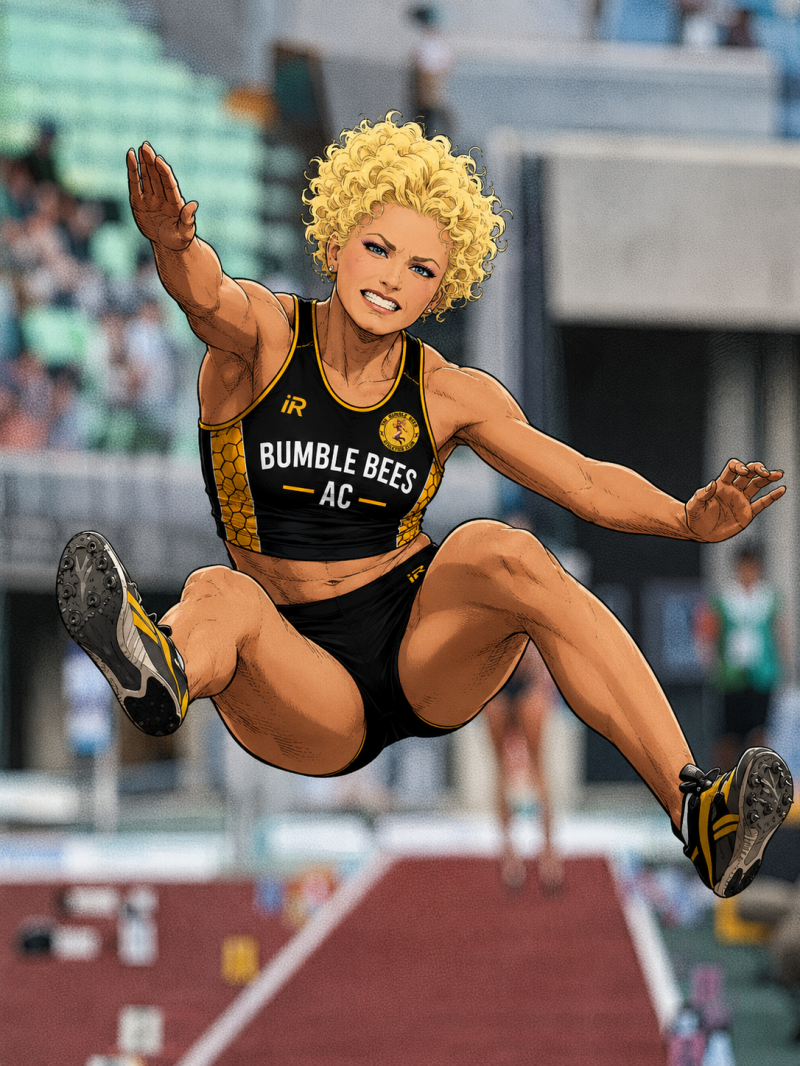
Kimberley Combe sets a mark of 5.58 in the North Wales Individual Regional Championships
Throws
Abigail Darling of Quemerford Harriers earns the Throws Performance of the Tournament following her 64.74-metre performance in the women’s discus.
Combined Events
Kai McAuliffe of Iron Road Runners produced the leading combined-events performance by winning the male pentathlon with 4,425 points, averaging 885 across the five disciplines.
Relays
Weymouth Bay Sharks receive the Relay Performance of the Tournament after their men’s 4×100m team recorded a personal-best 48.78.

Caledonian’s Beth Sherwood powers home in 37:03.12 in the womens 10,000m
The Individual Regional Championships have now reduced a programme of 1,396 entries to a qualifying list of 1,162.
East Scotland supplied the outstanding athlete and the largest club qualifying total. The South West produced the deepest and most unforgiving fields. South London delivered the closest fight for regional victories, while Yorkshire demonstrated that strength behind the winners could be every bit as important as winning itself.
Elsewhere, dominant clubs made their regional advantages count, smaller teams found isolated performances capable of leading the country, and several one-club regions discovered how their athletes measured up without a local rival alongside them.
Regional titles have been decided and the qualifying lists are set.
The results showed where Britain’s strongest performances were produced—but they also showed that the most valuable achievement was sometimes not victory, but simply finding a way through.
It remains to be seen how many more qualifiers there will be via the top 3 rankings route to the final.